
Astronomers Discover First Known Exomoon Orbiting Distant Celestial Body
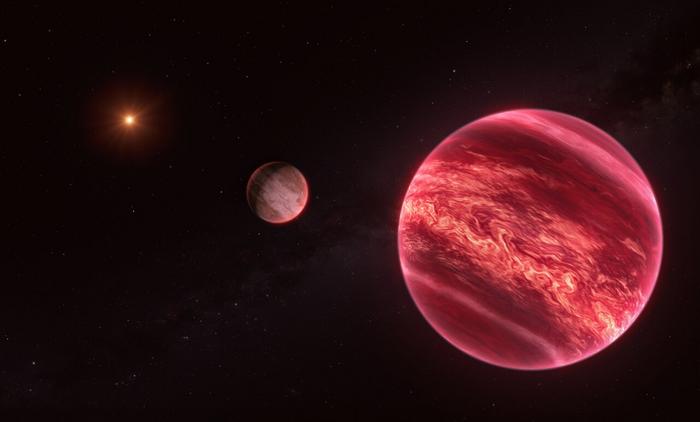
Astronomers have identified the first known exomoon, a moon orbiting a celestial body outside our solar system. This exomoon, located 71 light-years away in the CD-35 2772 system, is as massive as Jupiter and orbits a brown dwarf, an object…
 Miami Fort Lauderdale, FL, July 22, 2026 —
In a significant astronomical breakthrough, scientists have announced the discovery of the first confirmed exomoon, a moon orbiting a planet or other celestial body beyond our solar system.
The newly identified exomoon is located approximately 71 light-years from Earth within the CD-35 2772 system. This celestial object is notable for its immense size, possessing a mass comparable to that of Jupiter, the largest planet in our solar system.
The exomoon orbits a brown dwarf, a type of celestial object that falls into an intermediate category between planets and stars. Brown dwarfs are larger than planets but lack the sufficient mass to initiate sustained nuclear fusion, the process that powers stars.
The detection of this exomoon was achieved through the application of the radial velocity method. This technique involves observing the subtle gravitational tugs that an orbiting body exerts on its parent star or, in this case, its parent brown dwarf. These gravitational interactions cause detectable wobbles in the motion of the central celestial body, allowing astronomers to infer the presence and characteristics of unseen orbiting companions.
This discovery marks a pivotal moment in the search for celestial bodies outside our solar system and opens new avenues for understanding planetary and lunar formation in diverse cosmic environments.
Story summarized from the original created by Jeffrey Kluger on time.com, see more information here.
Media gallery
