Top-Rated Rhodiola Rosea Extract Company Demeterherb Compares Rosavin and Salidroside Specifications
XIAN, SHAANXI, CHINA, September 1, 2026 /EINPresswire.com/ -- Standardized Rhodiola sourcing is moving from plant-name
Press Release Disclaimer: This is a press release distributed through the XPR Media network. It has not been independently verified by our newsroom.

XIAN, SHAANXI, CHINA, September 1, 2026 /EINPresswire.com/ — Standardized Rhodiola sourcing is moving from plant-name recognition to measurable active compounds, analytical methods, and batch documents. As a Top-Rated Rhodiola Rosea Extract Company, Demeterherb distinguishes two commercially important sources: Rhodiola rosea extract, standardized by rosavins and salidroside, and Rhodiola crenulata extract, standardized primarily by salidroside. This distinction gives buyers a clearer basis for selecting a grade by botanical source and active-marker target rather than treating all Rhodiola extracts as interchangeable.
Demeterherb’s Rhodiola rosea options include 3% rosavins + 1% salidroside, 5% rosavins + 2% salidroside, and rosavin at 2% or 3%. Rhodiola crenulata extract is available with salidroside at 3%, 5%, 10%, 12%, or 98%. HPLC is used as the test method. These specifications support adaptogen, anti-hypoxia, and anti-fatigue formulation directions while keeping the raw-material identity and active marker explicit.
Approved Rhodiola Specification Range
Rhodiola rosea and Rhodiola crenulata should be treated as distinct raw-material specifications. Rhodiola rosea is commonly associated with rosavins together with salidroside, while Rhodiola crenulata is primarily standardized by salidroside. Demeterherb’s Rhodiola rosea grades include 3% rosavins + 1% salidroside and 5% rosavins + 2% salidroside, with rosavin-only options at 2% or 3%. Its Rhodiola crenulata grades cover salidroside from 3% through 98%.
This difference matters in procurement and formulation. A buyer specifying Rhodiola rosea should record the rosavin and salidroside targets together where applicable, while a Rhodiola crenulata order should state the salidroside target clearly. HPLC testing links the declared active percentage to the selected grade and commercial lot. Botanical identity, marker percentage, and test method should therefore travel together from sample approval through repeat orders.
Active-Marker Options Support Clear Formulation Decisions
Active-marker options support clearer formulation decisions because percentage data can be translated into formula input and cost. A formulation team can choose a Rhodiola rosea grade when rosavins and salidroside are both relevant to the product brief, or a Rhodiola crenulata grade when a defined salidroside concentration is the primary requirement. The selected percentage should remain consistent across the sample, specification sheet, COA, and commercial order.
Demeterherb’s role is to provide the selected botanical identity, HPLC-tested active specification, sample support, and batch documents. Product developers remain responsible for finished-product dosage, claim language, stability, and market-specific requirements. This keeps adaptogen, anti-hypoxia, and anti-fatigue positioning within an ingredient-development context rather than turning the raw-material specification into a guaranteed consumer outcome.
Marker concentration also changes the amount of extract required to reach a formula target. A higher-percentage grade can reduce the raw-material inclusion weight, while a lower-percentage grade may fit a different serving size, carrier system, or cost structure. The calculation must still start from the approved botanical identity. A formulation developed with Rhodiola rosea at 5% rosavins + 2% salidroside should not be scaled with a different Rosea grade or with Rhodiola crenulata without a new formula review. Keeping the selected species and marker level fixed helps formulation, purchasing, and quality teams work from the same input when the project moves from laboratory sample to pilot production.
Two Rhodiola Species Create Different Sourcing Paths
Two Rhodiola species create different sourcing paths because the preferred marker profile is not the same. Rhodiola rosea, also known as golden root or Arctic root, is selected when rosavins are part of the specification. Rhodiola crenulata is selected when salidroside concentration is the primary marker. Buyers should therefore identify the botanical source first and then select the active range that fits the formulation.
For Rhodiola rosea, Demeterherb can supply 3% rosavins + 1% salidroside, 5% rosavins + 2% salidroside, and rosavin at 2% or 3%. For Rhodiola crenulata, salidroside options include 3%, 5%, 10%, 12%, and 98%. HPLC testing provides a consistent analytical basis across these standardized grades.
Species and marker targets should be locked together before a buyer compares price or dosage-form economics. For Rhodiola rosea, a 3% rosavins + 1% salidroside grade is a different purchase specification from a 5% rosavins + 2% salidroside grade or a rosavin 2%/3% option. Rhodiola crenulata follows a separate salidroside-centered path, with 3%, 5%, 10%, 12%, and 98% grades. Treating those materials as one interchangeable “Rhodiola extract” can create errors in quotation review, formula calculations, and repeat ordering. A controlled purchase specification should therefore state the botanical species, the exact active-marker target, the HPLC method, and the corresponding COA requirement before the sample is approved.
Quality Systems Turn Product Selection into Supplier Verification
Quality systems support supplier verification after the botanical source and active specification are selected. Demeterherb operates with GMP-standard production and quality credentials that include TÜV Rheinland Factory Certification, ISO22000, HACCP, HALAL, and Kosher. Rhodiola qualification should still remain product-specific: the COA, HPLC result, botanical identity, and selected rosavin or salidroside target control the released lot.
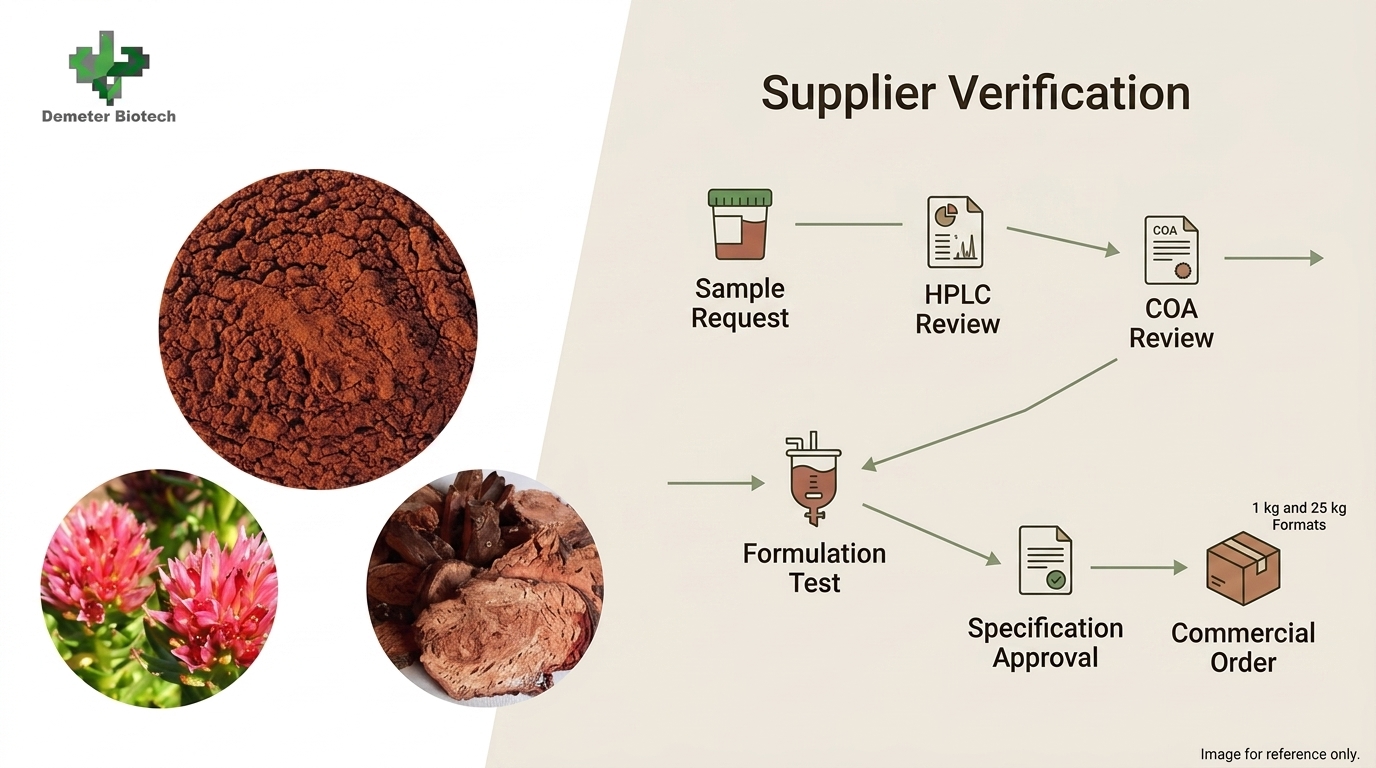
Company-level credentials establish the organizational quality background, while the Rhodiola COA establishes the released batch. A buyer can therefore move from sample request to HPLC review, specification approval, and commercial order without substituting a corporate credential for product data. This separation is especially useful when a portfolio includes both Rhodiola rosea and Rhodiola crenulata grades.
Lot release should preserve the same identity established during sampling. The sample label, specification sheet, HPLC result, and COA should all refer to the same Rhodiola species and active-marker grade. For example, a 98% salidroside Rhodiola crenulata lot and a 5% rosavins + 2% salidroside Rhodiola rosea lot belong to different product definitions even though both are sold within the Rhodiola category. This separation makes repeat orders easier to audit and reduces the risk of a commercial shipment being accepted on a general botanical name while its marker profile differs from the approved material.
Global Service Supports Rhodiola Projects from Sample to Commercial Order
Global service supports Rhodiola projects through samples, documents, packaging, and delivery. Xi’an Demeter Biotech Co., Ltd. supplies ingredient customers across more than 50 countries and regions. Available packaging includes 1 kg and 25 kg formats, while private label and logistics services can support the transition from standardized raw material to a market-ready format.
A regional brand can begin with a Rhodiola rosea or Rhodiola crenulata sample and define the dosage form, target active marker, market, and stability requirements. Demeterherb can then provide the selected sample and certificate of analysis under the corresponding HPLC-tested specification. Keeping the species and marker target explicit prevents a general ‘Rhodiola extract’ request from becoming an ambiguous commercial order.
Demeterherb’s Rhodiola proposition is grounded in species identity, HPLC testing, certificate-of-analysis support, and flexible marker specifications across Rhodiola rosea and Rhodiola crenulata. Buyers can visit https://www.demeterherb.com/ to request the current Rhodiola specification, sample, COA, packaging options, and quotation.
Xi’an Demeter Biotech Co., Ltd.
Demeterherb
email us here
Visit us on social media:
LinkedIn
Facebook
X
Legal Disclaimer:
EIN Presswire provides this news content “as is” without warranty of any kind. We do not accept any responsibility or liability
for the accuracy, content, images, videos, licenses, completeness, legality, or reliability of the information contained in this
article. If you have any complaints or copyright issues related to this article, kindly contact the author above.

Media gallery