Bio Vanillin Market to Reach USD 570.10 Million by 2035, Growing at 5.37% CAGR
Bio vanillin market reaches USD 570.10 Million by 2035 as demand for sustainable, bio-based flavoring grows across
Press Release Disclaimer: This is a press release distributed through the XPR Media network. It has not been independently verified by our newsroom.
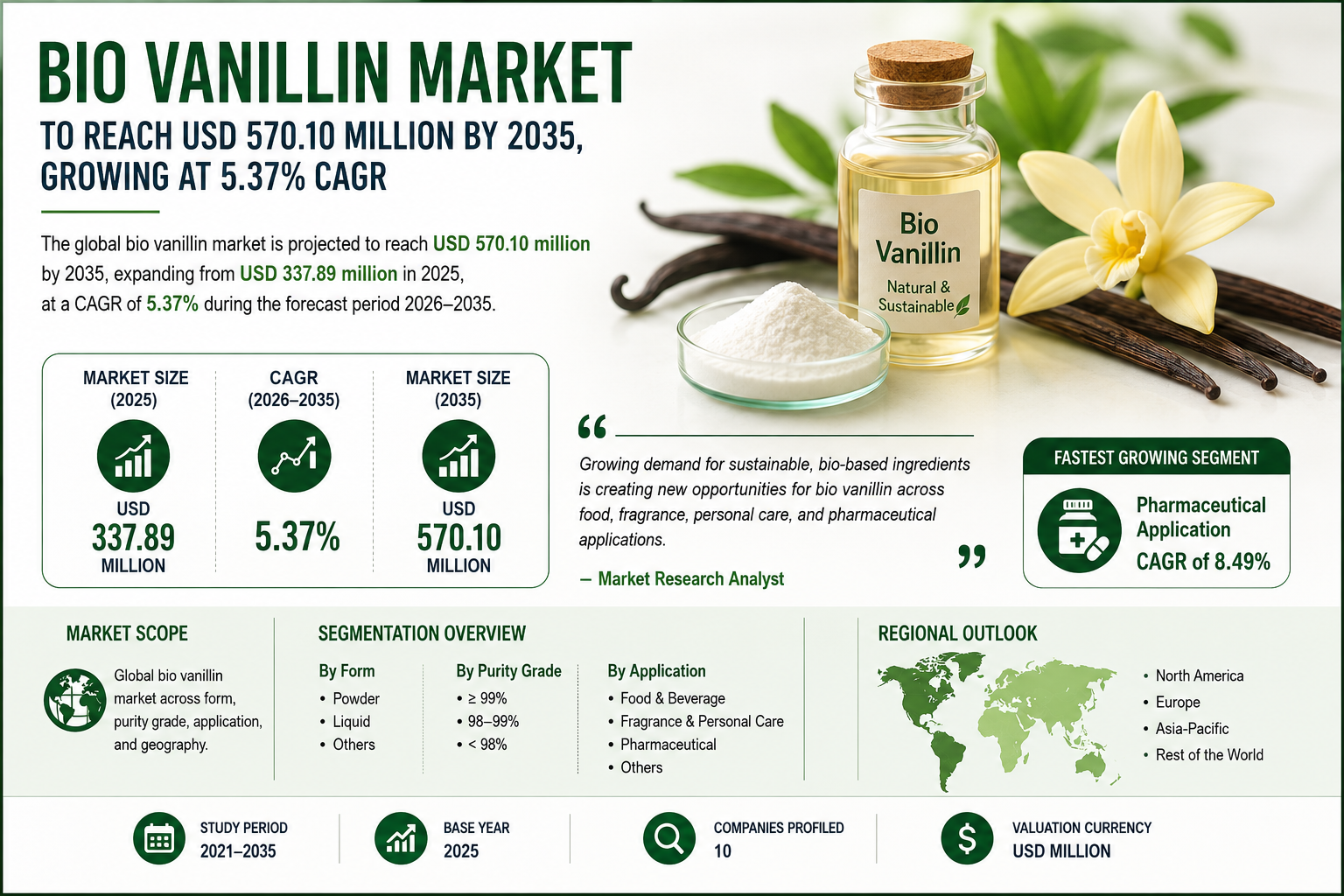

Bio vanillin market reaches USD 570.10 Million by 2035 as demand for sustainable, bio-based flavoring grows across food, fragrance & pharmaceuticals.
NEW YORK, NY, UNITED STATES, August 20, 2026 /EINPresswire.com/ — The global Bio Vanillin Market is projected to expand from USD 337.89 million in 2025 to USD 570.10 million by 2035, registering a compound annual growth rate (CAGR) of 5.37% during 2026–2035, according to the latest market assessment. The market is being shaped by growing interest in bio-based ingredients, increasing demand for sustainable flavoring solutions, and the expanding use of vanillin across food and beverage, fragrance, personal care, and pharmaceutical applications.
Bio vanillin has emerged as an important alternative within the broader vanillin industry as manufacturers and brands increasingly evaluate ingredient sourcing, production methods, environmental impact, and consumer preferences. The transition toward bio-based and naturally positioned ingredients is encouraging producers to explore technologies capable of delivering consistent aromatic profiles while reducing dependence on conventional petrochemical-based production routes.
The market study covers the global bio vanillin industry across form, purity grade, application, and geography, with a study period spanning 2021–2035. The report provides a detailed assessment of market development, growth opportunities, application trends, regional dynamics, competitive activity, and factors influencing adoption through the forecast period.
Get Full PDF Sample Copy of Report: (Including Full TOC, List of Tables & Figures, Chart) @ https://www.marketresearchfuture.com/sample_request/31831
Bio Vanillin Market Overview
Vanillin is the principal compound responsible for the characteristic vanilla aroma and flavor associated with vanilla. While traditionally associated with vanilla beans, commercial vanillin can be produced through several pathways. Bio vanillin represents a growing category in which biological, fermentation-based, or other bio-derived production approaches can support the development of vanillin ingredients aligned with evolving clean-label and sustainability priorities.
The global bio vanillin market is benefiting from the intersection of several long-term trends. Food manufacturers are responding to consumer interest in recognizable and responsibly sourced ingredients, while fragrance and personal care companies continue to seek aromatic ingredients with desirable performance and sourcing characteristics. At the same time, advances in biotechnology and fermentation are expanding the potential for commercially viable production of specialty ingredients.
With the market forecast to increase by more than USD 230 million between 2025 and 2035, the industry is expected to attract continued attention from ingredient producers, food and beverage companies, pharmaceutical manufacturers, fragrance houses, technology developers, and investors.
The growth trajectory also reflects the broad versatility of vanillin. The ingredient can contribute characteristic flavor and aroma profiles to a wide variety of formulations, making its commercial potential closely connected with developments in consumer packaged goods and specialty ingredient markets.
Market Growth Driven by Sustainable Ingredient Demand
One of the most important factors supporting the bio vanillin market is the increasing emphasis on sustainable sourcing and bio-based manufacturing.
Consumers are increasingly examining ingredient labels and showing interest in products positioned around natural, clean-label, plant-based, and environmentally responsible attributes. These preferences are influencing formulation strategies throughout the food, beverage, cosmetics, and personal care industries.
For manufacturers, bio-based production can provide an avenue for developing ingredients that fit sustainability-oriented product strategies. This is particularly relevant for companies seeking alternatives to conventional chemical synthesis or looking to diversify raw-material sourcing.
The trend is also supported by broader corporate sustainability objectives. Consumer goods companies are setting targets around responsible sourcing, emissions reduction, renewable feedstocks, and more transparent supply chains. Ingredient suppliers that can demonstrate consistent quality alongside credible sustainability characteristics may therefore gain a competitive advantage.
At the same time, the commercialization of bio vanillin remains dependent on production economics, scalability, feedstock availability, regulatory considerations, and the ability to maintain consistent product quality at industrial volumes.
Pharmaceutical Application Emerges as the Fastest-Growing Segment
Among the applications covered in the market assessment, the pharmaceutical application segment is projected to record the fastest growth, advancing at a CAGR of 8.49% during the forecast period.
The expanding pharmaceutical application base highlights the versatility of vanillin beyond its traditional role as a flavoring and fragrance ingredient. In pharmaceutical formulations, flavor and sensory characteristics can be important considerations, particularly for products where taste and palatability influence consumer acceptance.
The increasing development of patient-friendly formulations and more sophisticated drug-delivery products may create additional opportunities for specialty flavoring ingredients. Bio vanillin can potentially support formulation strategies where manufacturers are seeking differentiated ingredient sourcing while maintaining desired sensory characteristics.
The pharmaceutical segment’s faster projected growth also indicates an opportunity for suppliers to develop specialized grades and formulations designed around the technical requirements of pharmaceutical manufacturing.
As pharmaceutical companies continue to emphasize product quality, consistency, safety, and regulatory compliance, suppliers capable of providing reliable specifications and documentation are expected to remain important participants in the value chain.
Food and Beverage Remains a Key Application Area
Food and beverage represents one of the most important commercial environments for vanillin, supported by the ingredient’s widespread use in products ranging from bakery and confectionery to dairy, beverages, desserts, and processed foods.
Vanilla flavor profiles remain highly recognizable among consumers, and manufacturers use vanillin to deliver consistent sensory characteristics across large-scale product formulations. The availability and economics of vanilla-derived ingredients can vary, creating opportunities for alternative production pathways.
Bio vanillin may benefit from the increasing convergence of flavor performance and sustainability requirements. Food manufacturers are looking for ingredients that can provide reliable sensory performance while supporting product positioning around responsible sourcing and cleaner ingredient narratives.
The growth of premium foods, plant-based products, functional beverages, and innovative confectionery products may further expand the potential application base. Manufacturers are also increasingly experimenting with new flavor combinations, creating opportunities for specialty flavor ingredients that provide familiar vanilla characteristics across diverse product categories.
Fragrance and Personal Care Applications Create Additional Opportunities
Vanillin’s distinctive aroma makes it valuable to fragrance and personal care manufacturers. Vanilla-associated notes are widely used in perfumes, body care products, cosmetics, soaps, and other fragranced consumer products.
The fragrance industry’s interest in bio-based ingredients is creating another avenue for market development. As brands explore renewable and responsibly sourced raw materials, bio vanillin can become part of broader efforts to develop fragrance portfolios with alternative ingredient pathways.
Personal care companies are likewise responding to consumers who increasingly associate ingredient sourcing with product values. Bio-based aromatic ingredients may therefore support innovation in formulations marketed around sustainability and responsible manufacturing.
The opportunity is not limited to finished consumer products. Fragrance houses, ingredient distributors, and formulation specialists can potentially incorporate bio vanillin into broader portfolios of specialty aroma materials, allowing manufacturers to differentiate their offerings and respond to evolving customer requirements.
Market Segmentation by Form and Purity Grade
The global bio vanillin market is analyzed across different forms and purity grades, reflecting the varying technical requirements of end-use industries.
Form is an important consideration because manufacturers require ingredients that can be efficiently handled, transported, stored, blended, and incorporated into their specific formulations. Different end-use sectors may prioritize characteristics such as solubility, stability, concentration, handling properties, and compatibility with other formulation components.
Purity grade is similarly important. Food, pharmaceutical, fragrance, and industrial applications can have different specifications and quality requirements. As the market expands, suppliers may increasingly focus on specialized grades designed for particular applications rather than relying exclusively on standardized offerings.
This segmentation creates opportunities for manufacturers to compete through product quality, consistency, technical support, documentation, and application-specific expertise.
Regional Outlook
The global bio vanillin market encompasses North America, Europe, Asia-Pacific, and other regional markets, each presenting distinct opportunities and market dynamics.
North America is expected to remain an important market due to the established food and beverage, pharmaceutical, fragrance, and personal care industries in the region. Consumer interest in sustainable products and alternative ingredient sourcing can support adoption, while established ingredient supply chains provide manufacturers with access to specialized raw materials and technologies.
Europe represents another significant opportunity center, particularly given the region’s emphasis on sustainability, traceability, responsible sourcing, and environmental performance. Food, cosmetics, and fragrance companies operating in European markets are increasingly incorporating sustainability considerations into product development and procurement decisions. These dynamics can create opportunities for bio-based flavor and aroma ingredients.
Asia-Pacific offers considerable long-term potential due to expanding food and beverage production, rising consumer purchasing power, industrial development, and the growing pharmaceutical and personal care sectors. As manufacturers across the region increase their focus on product differentiation and sustainability, demand for specialty bio-based ingredients may increase.
Emerging economies in Asia and other regions may also contribute to future market expansion as modern retail, packaged food consumption, pharmaceutical manufacturing, and personal care markets continue to develop.
Technology and Innovation Shape the Competitive Landscape
Technological development is expected to remain central to the evolution of the bio vanillin market.
Advances in biotechnology, fermentation, feedstock processing, purification, and downstream manufacturing can influence the industry’s ability to produce bio vanillin at commercial scale. Improving yields and process efficiency can help suppliers address one of the central challenges facing bio-based specialty ingredients: achieving competitive economics without compromising quality.
Research and development efforts may also focus on improving consistency between production batches, optimizing feedstock utilization, reducing manufacturing waste, and enhancing scalability.
The competitive environment is therefore likely to involve more than conventional price competition. Companies with strong biotechnology capabilities, intellectual property, production infrastructure, application expertise, and established customer relationships may be better positioned to capture emerging opportunities.
The market report profiles 10 companies, providing insight into the competitive structure and strategic positioning of participants in the global bio vanillin industry.
Key Market Drivers
Several structural factors are expected to support market expansion through 2035.
First, the continuing shift toward bio-based and sustainable ingredients is encouraging manufacturers to evaluate alternatives to conventional production routes.
Second, the expanding clean-label and natural-product movement is influencing ingredient selection across food, beverage, cosmetics, and personal care markets.
Third, increasing consumer demand for consistent flavor and aroma experiences supports continued use of vanillin across mass-market and premium products.
Fourth, advances in biotechnology and fermentation are improving the technical potential of bio-based ingredient manufacturing.
Fifth, expanding pharmaceutical and specialty formulation applications create opportunities beyond traditional food and fragrance markets.
Finally, multinational consumer brands are increasingly incorporating sustainability considerations into procurement and product development, creating potential demand for suppliers capable of delivering traceable, scalable, and consistent bio-derived ingredients.
Challenges and Market Restraints
Despite its positive growth outlook, the bio vanillin market faces several challenges.
Production economics remain a significant consideration. Bio-based manufacturing processes must compete with established conventional production methods, and commercial success depends on achieving appropriate yields, process efficiency, raw-material availability, and production scale.
Feedstock availability and cost can also affect supply stability. Producers must establish reliable sourcing systems capable of supporting consistent industrial production while meeting sustainability objectives.
Another challenge is maintaining product quality and consistency at scale. End-use industries such as pharmaceuticals, food, and fragrances require precise specifications, and variations in purity or sensory characteristics can affect formulation performance.
Regulatory and labeling requirements may also differ across countries and applications. Companies expanding globally must navigate market-specific requirements relating to ingredient classification, safety, labeling, and permitted claims.
These challenges create opportunities for companies that can combine biotechnology expertise with robust quality systems, efficient manufacturing, regulatory knowledge, and established distribution networks.
Strategic Opportunities Through 2035
The forecast period is expected to create several strategic opportunities for market participants.
Ingredient producers can pursue capacity expansion and process optimization to improve economies of scale. Technology companies can focus on fermentation platforms and bio-based production systems capable of generating specialty ingredients more efficiently.
Food and beverage companies may explore bio vanillin as part of broader clean-label and sustainability initiatives, while fragrance and personal care manufacturers can use bio-based aromatic ingredients to strengthen environmentally oriented product portfolios.
Pharmaceutical manufacturers represent another attractive opportunity, particularly given the segment’s projected 8.49% CAGR, which makes pharmaceutical applications the fastest-growing segment identified in the market outlook.
Strategic partnerships may also become increasingly important. Collaboration among biotechnology developers, ingredient manufacturers, consumer brands, research organizations, and distributors can help accelerate commercialization, expand production capabilities, and address application-specific technical requirements.
Outlook
The global bio vanillin market is positioned for steady expansion over the next decade. From a market valuation of USD 337.89 million in 2025, the industry is forecast to reach USD 570.10 million by 2035, representing a 5.37% CAGR from 2026 to 2035.
The market’s development will be shaped by the growing importance of sustainable ingredient sourcing, advances in bio-based manufacturing technologies, expanding end-use applications, and changing consumer expectations around product ingredients.
While food and beverage and fragrance applications remain central to the commercial opportunity, the faster growth anticipated in pharmaceutical applications demonstrates the potential for bio vanillin to expand into specialized and higher-value markets.
Companies that successfully combine reliable production, consistent quality, application-specific product development, competitive economics, and credible sustainability strategies are likely to be well positioned as demand develops.
As ingredient innovation continues to converge with biotechnology and sustainability, bio vanillin is expected to become an increasingly relevant component of the global specialty flavor and aroma ingredient landscape.
Discover Related Research Reports By Market Research Future:
Bio Seed Market
https://www.marketresearchfuture.com/reports/bio-seed-market-29481
Natural Pet Food Market
https://www.marketresearchfuture.com/reports/natural-pet-food-market-12493
Raw Pet Food Market
https://www.marketresearchfuture.com/reports/raw-pet-food-market-23005
Sagar Kadam
Market Research Future
email us here
+1 628-258-0071
Visit us on social media:
LinkedIn
Facebook
YouTube
X
Legal Disclaimer:
EIN Presswire provides this news content “as is” without warranty of any kind. We do not accept any responsibility or liability
for the accuracy, content, images, videos, licenses, completeness, legality, or reliability of the information contained in this
article. If you have any complaints or copyright issues related to this article, kindly contact the author above.

Media gallery