
Phenom WorkOps Moves Enterprises to Multi-Agent Solutions for HR’s Biggest Challenges
Results show WorkOps turning isolated AI agents into one orchestrated, governed system across hiring, development and
Press Release Disclaimer: This is a press release distributed through the XPR Media network. It has not been independently verified by our newsroom.


Phenom, the leader in applied AI built to redesign work operations for hiring faster, developing better and retaining longer, announced new business impact results from WorkOps, its orchestration and governance system for coordinating AI agents across hiring, onboarding, development and retention. Enterprises using WorkOps to orchestrate multiple agents under one policy layer report ROI gains including 50% faster hiring, a 40% increase in internal mobility, and 10+ hours a week returned to recruiters for strategic focus. As enterprises extend agents beyond a single task across talent acquisition and management, these outcomes only compound.
This press release features multimedia. View the full release here: https://www.businesswire.com/news/home/20260804036887/en/
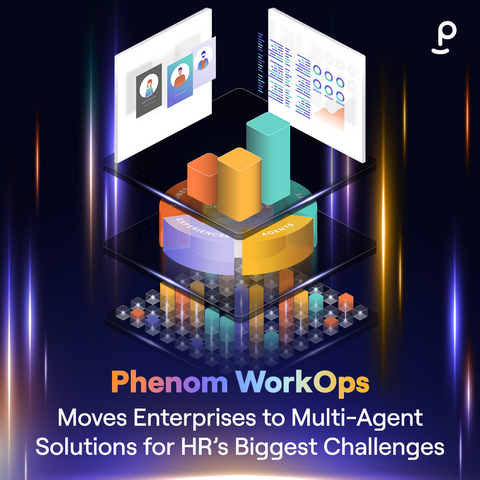
Phenom announced new business impact results from WorkOps, its orchestration and governance system for coordinating AI agents across hiring, onboarding, development and retention.
Most enterprises can get one AI agent to work on a single task, such as screening candidates or flagging a retention risk. Far fewer have built the governance to orchestrate that agent across an entire workflow, let alone connect hiring, development and retention agents under one policy. Gartner predicts that more than 40% of agentic AI projects will be canceled by the end of 2027, citing escalating costs, unclear business value and inadequate risk controls. These projects rarely fail on a single agent’s performance. They fail once that agent has to work across a wider workflow or a second agent enters from another part of the talent lifecycle, with no policy to govern how they interact. WorkOps is involved from the beginning, guiding organizations through their initial rollout to build agent fluency and trust, allowing them to expand easily across workflows.
The Compounding Results When Agent Deployments Scale Across the Talent Lifecycle
A growing number of companies across industries are seeing real business impact after rolling out their first AI agent:
- A healthcare provider cut time to offer in half in the first few months, saved 400 recruiter hours a month and completed 92% of screenings within one business day
- A major retailer saved 17,000 recruiter hours annually while eliminating the five- to seven-day gap between application and first candidate contact
- A leading manufacturer doubled screening completion rates to 80% within months of rollout, with most candidates responding within 1.5 hours of first contact
The significant results from single agents is pushing enterprises to consider multi-agent deployment, where Phenom WorkOps applies orchestration and governance across the workflow:
- A family services company using a Voice Agent for screening extended agentic voice capabilities by adding a Reference Check Agent, saving an additional 3.5 recruiter hours a week per talent acquisition coordinator
- A manufacturing organization already giving back 70 recruiter hours in the first month with Voice Agent added Intake and Sourcing Agents to the hiring workflow, streamlining communication with hiring managers and immediately surfacing qualified candidates
None of these deployments began as a full lifecycle rollout. Each organization started with a single agent on a single task before extending and connecting others as confidence and results grew. The policy layer ensures expansions operate smoothly, preventing challenges such as conflicting actions, duplicated work and unauthorized access.
Agentic Orchestration Governance: Empowering Enterprises to Move Agents from One Task to Full Workflows
Automation executes what a team already decided, and a single agent completes a defined task. Neither adapts when an exception occurs: a hiring manager goes dark, a market shifts overnight, a high performer’s flight risk score changes or an agent’s work needs to hand off to the next step. WorkOps was built to address this coordination problem, and policy is the mechanism that solves it.
Independent deployment makes this harder. Adding a screening agent, skills validation agent and career coach agent on their own produces three systems that do not talk to each other. This is the difference between deploying agents and governing them across the talent lifecycle: WorkOps runs every agent under one policy layer, so extending across hiring, development, and retention strengthens the system instead of adding another element to manage.
In practice, a talent leader describes a need in plain language to a conversational AI policy agent, setting screening thresholds, escalation paths, succession triggers or scheduling cadence. The Orchestration Engine converts that description into structured policy with no workflow configuration. Guardrail policies set the boundaries agents cannot cross, such as never auto-rejecting a referred candidate or extending an offer above a compensation band without approval. Routing policies define the triggers that move work from one agent to the next, or to a person, such as: activating a Voice Screening Agent when recruiter availability drops below a set threshold and escalating to an HR business partner when a hiring manager goes unresponsive, or rerouting a candidate to an alternate role when onboarding clearance returns restrictions. Both are enforced automatically and stay visible to HR stakeholders without an IT translation layer.
While this policy works well for one hiring scenario, it should not be universally applied everywhere, since screening thresholds and escalation paths can be unique for each role. A Hypercell framework helps by providing context, defining each unit of work as the intersection of industry, role, function, geography and workflow. This gives the Orchestration Engine additional data to apply the right policy correctly, whether the work is hiring, development or retention: an ICU nurse opening in a severe shortage market like Dallas activates immediate voice screening and compressed scheduling, while the same role in a balanced market like Minneapolis optimizes for deeper candidate assessment. Every policy applied, every agent action taken and every case escalated for human review is captured in a live execution log, giving HR and IT teams full auditability without building a separate reporting layer.
“AI agents that lack governance and cannot understand an enterprise’s unique industry, roles and workflow will fall short on impact. This is why so many AI pilots stall,” said Mahe Bayireddi, CEO and co-founder of Phenom. “The companies pulling ahead give their agents both the precise context to act correctly and the governance that scales across the entire workflow.”
Go Deeper into WorkOps & Multi-Agent Deployment at the Ai4 Conference in Vegas
Hear Bayireddi discuss embracing AI-augmented work and shifting skills towards requirements that require human judgment during his session “Redesigning Workflows and Driving Change Management for Agentic AI” at the Ai4 conference on Aug. 5.
To learn more about WorkOps and Phenom’s agentic governance model, watch Phenom’s Applied AI Keynote announcement on demand.
About Phenom
Phenom is the leader in applied AI built to redesign work operations for hiring faster, developing better and retaining longer. It understands unique industry and business needs for departments, teams, employees and candidates. This is AI that knows company DNA, powered by Engines that harmonize data and facilitate orchestration, Ontologies that guide every decision, X AI that creates hyper-personalized experiences, and Agents that work alongside teams with unprecedented speed and precision. Driven by a purpose to help a billion people find the right work, this is responsible AI that is enterprise-secure, compliant, and always explainable.
Phenom has earned accolades including: Inc. 5000’s fastest-growing companies (6 consecutive years), Deloitte Technology’s Fast 500 (5 years), 11 Brandon Hall ‘Excellence in Technology’ awards including Gold for ‘Best Advance in Generative AI for Business Impact,’ Business Intelligence Group’s Artificial Intelligence Excellence Awards (3 consecutive years), The Cloud Awards 2025/2024, The A.I. Awards 2024, and a regional Timmy Award for launching and optimizing HelpOneBillion.com (2020).
Headquartered in Greater Philadelphia, Phenom also has offices in Canada, India, Israel, the Netherlands, Germany and the United Kingdom.
For more information, please visit www.phenom.com. Connect with Phenom on LinkedIn, X, Facebook, YouTube, Instagram and TikTok.
View source version on businesswire.com: https://www.businesswire.com/news/home/20260804036887/en/
Media gallery


