
Vast Edge Expands Healthcare Claims Management Platform with AI-Powered Claims Analytics and Denial Pattern Visibility
New capabilities bring AI-assisted claims analytics, denial visibility, and workflow insights for healthcare providers,
Press Release Disclaimer: This is a press release distributed through the XPR Media network. It has not been independently verified by our newsroom.
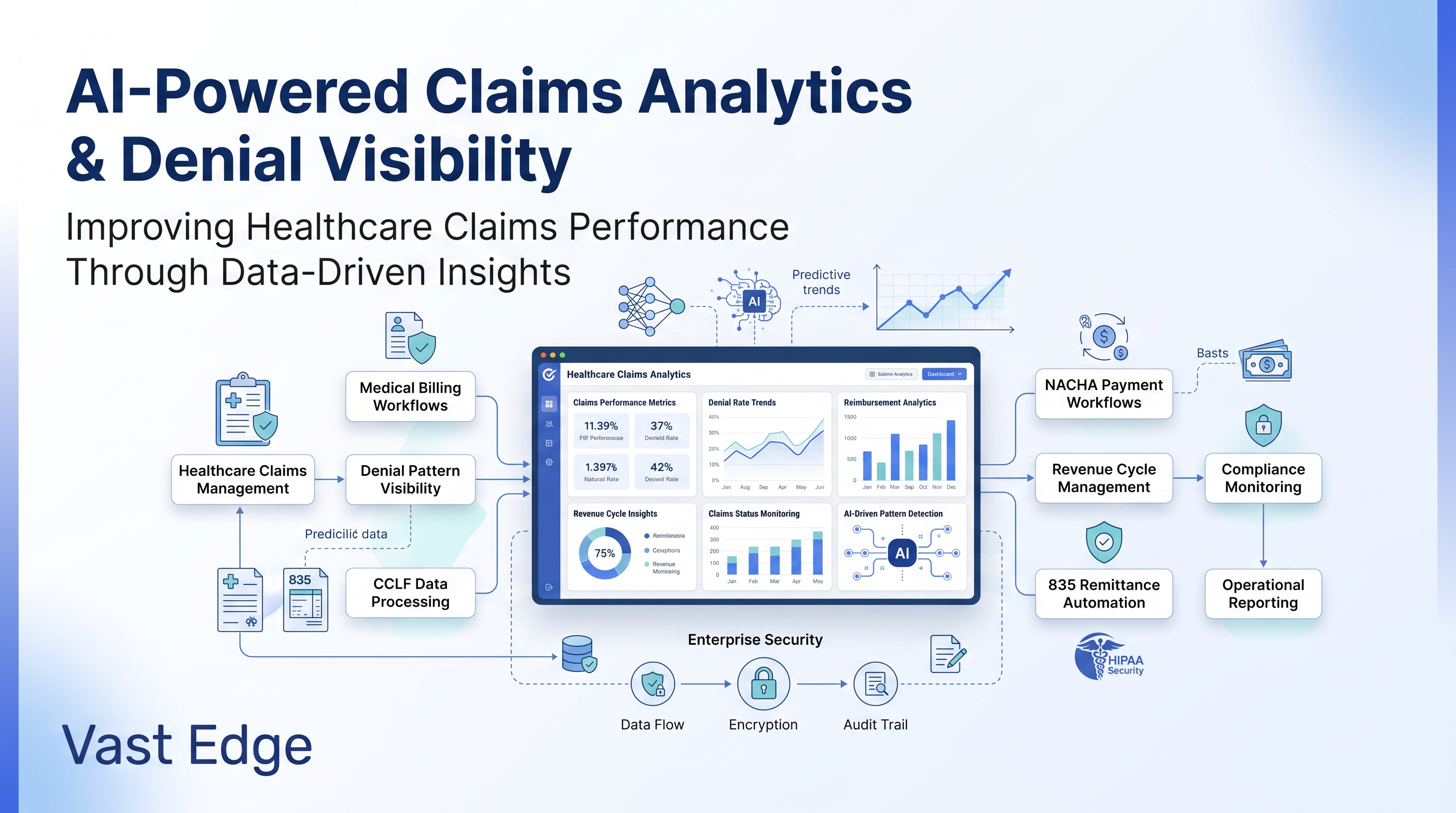

New capabilities bring AI-assisted claims analytics, denial visibility, and workflow insights for healthcare providers, ACOs, and revenue cycle teams.
SUNNYVALE, CA, UNITED STATES, July 23, 2026 /EINPresswire.com/ — Vast Edge, a healthcare technology and enterprise cloud solutions provider, today announced the expansion of its healthcare claims management software with new AI-powered claims analytics, denial pattern visibility, and operational reporting capabilities. The enhancements are designed to help healthcare providers, Accountable Care Organizations (ACOs), and revenue cycle management teams improve visibility into claims performance, identify recurring denial patterns, and support more informed reimbursement decision-making.
The updates reflect growing demand among healthcare organizations for data-driven tools that provide actionable claims intelligence without replacing the clinical and administrative judgment that effective revenue cycle management requires.
Why Healthcare Claims Operations Are Becoming More Complex
Claims processing in healthcare has become measurably more complex over the past several years. Payer rule changes, evolving coding requirements, increasing claims volumes, and the administrative burden of managing CCLF data, 835 remittance workflows, and NACHA payment files have placed significant pressure on revenue cycle teams that were already operating with constrained resources.
Claim denial rates remain a persistent challenge across the industry. When denials are not systematically analyzed, the same coding errors, eligibility issues, and authorization gaps recur across claim submissions without being addressed at the root level. Manual denial review processes are time-intensive and often lack the pattern recognition needed to identify which denial categories are driving the largest reimbursement impact.
At the same time, ACOs participating in the CMS Shared Savings Program are managing large volumes of CCLF file data that require integration, validation, and analysis to support beneficiary assignment reporting, expenditure reconciliation, and care coordination workflows. Processing these files manually creates delays and introduces data integrity risks that affect both financial reporting and compliance.
The operational reality for many healthcare organizations is that claims data exists in sufficient volume to support better decision-making, but the tools to extract meaningful intelligence from that data have not always been accessible within the claims management workflow itself.
How AI-Assisted Claims Analytics Works
AI-assisted claims analytics applies pattern recognition and trend analysis to claims data to surface operational insights that would be difficult to identify through manual review alone. Within Vast Edge’s expanded healthcare claims management system, AI-powered analytics continuously analyzes submitted claims, remittance data, and denial records to identify trends, flag anomalies, and generate reporting that supports revenue cycle decision-making.
The analytics layer examines claim submission patterns across payer types, procedure codes, provider groups, and service dates. It identifies where claims are consistently adjudicated at lower reimbursement rates than expected, flags submission patterns that correlate with higher denial rates, and surfaces coding inconsistencies that may affect first-pass claim acceptance.
Importantly, AI-assisted claims analytics in this context functions as decision support, not autonomous processing. Clinical coders, billing specialists, and revenue cycle managers retain full decision-making authority. The analytics layer surfaces information and trends that help those professionals prioritize their attention and make better-informed coding and submission decisions.
Understanding Denial Pattern Visibility
Denial pattern visibility is the operational capability to identify, categorize, and track claim denial trends across a defined time period, payer mix, and claim type. Without systematic denial pattern visibility, revenue cycle teams typically respond to denials individually rather than addressing the underlying causes that generate recurring denials across claim populations.
What does denial pattern visibility look like in practice?
It enables teams to answer questions such as:
Which denial reason codes are appearing most frequently this quarter?
Which payers are generating the highest denial rates for specific procedure categories?
Are denial rates increasing or decreasing following a coding workflow change?
Which providers or departments are generating a disproportionate share of correctable denials?
Vast Edge’s denial pattern visibility capability within its medical claims management software organizes denial data by reason code, payer, provider, and service category. Trend analysis identifies whether denial rates in specific categories are stable, improving, or worsening over defined reporting periods. Root cause reporting helps revenue cycle managers distinguish between denials that require payer follow-up and denials that reflect correctable internal process gaps.
Operational Benefits for Healthcare Organizations
The operational benefits of AI-powered claims analytics and denial pattern visibility are most visible in the revenue cycle workflows where claims data has historically been analyzed inconsistently or not at all.
For billing teams, denial trend analysis reduces the time spent identifying which denial categories to prioritize. Rather than reviewing individual denials without context, billing specialists can focus their correction and resubmission efforts on the categories with the highest volume and reimbursement impact.
For medical coding teams, AI-assisted claims intelligence provides feedback on which coding patterns are associated with higher denial rates, supporting more consistent application of coding guidelines across providers and departments. This capability addresses one of the persistent challenges in automated medical billing system environments: ensuring that coding accuracy improvements persist over time rather than degrading as staff changes or payer rules evolve.
For ACO finance and compliance teams, integrated CCLF analytics provide reporting on beneficiary-level claims activity, expenditure trends, and care coordination data that supports Shared Savings Program reporting and population health management. The platform’s three-year historical CCLF claims analysis capability allows ACOs to assess trends across benchmark periods rather than only examining current-period data.
Healthcare Claims Workflow Intelligence
Workflow intelligence within a healthcare claims management system refers to operational visibility into where claims are in the adjudication process, where delays are occurring, and which workflow stages are generating the most rework.
Vast Edge’s expanded platform provides real-time claim status tracking throughout the adjudication lifecycle, flagging claims that have been pending beyond expected adjudication timeframes and identifying workflow bottlenecks that affect cash flow velocity. 835 Electronic Remittance Advice processing is automated, reducing manual payment posting and providing consistent remittance data for reconciliation reporting.
NACHA file generation for electronic payment processing is integrated directly into the claims workflow, allowing organizations to initiate vendor payment workflows without manual file creation. Same-day 835 and NACHA file generation upon receipt of claim reduction files reduces the time between adjudication and payment processing.
The benefits of medical billing software with integrated workflow intelligence extend beyond operational efficiency. Better workflow visibility supports more accurate accounts receivable aging reporting, improves communication between billing, coding, and clinical teams, and provides the operational data finance leaders need for revenue cycle performance assessment.
Executive Perspective
“Healthcare revenue cycle teams are dealing with increasing claims volume, more complex payer requirements, and growing reporting obligations while working to maintain reimbursement performance,” said a spokesperson for Vast Edge.
“The analytics and denial visibility capabilities we have added to our healthcare claims management platform are designed to give those teams better information about what is happening across their claims operations, so they can direct their attention to the areas where intervention will have the most impact. The goal is to support clinical and administrative judgment with better data, not to replace it.”
About Vast Edge
Founded in 2004, Vast Edge delivers enterprise software, cloud solutions, AI-based analytics, security, enterprise disaster recovery solutions, and managed services to organizations across multiple industries. The company also provides healthcare claims management software, AI-assisted claims analytics, CCLF integration and reporting, 835 and NACHA workflow automation, and cloud infrastructure services for healthcare providers, ACOs, and revenue cycle management organizations. Vast Edge supports EMR integration with EPIC and ALLSCRIPTS, HIPAA-compliant data hosting, and enterprise-scale claims processing workflows across payer environments.
Vast Edge is headquartered in Sunnyvale, California. Additional information is available at VastEdge.com.
Vik Mehta
Vast Edge
+1 408-386-6386
vik@vastedge.com
Visit us on social media:
LinkedIn
Facebook
YouTube
X
Legal Disclaimer:
EIN Presswire provides this news content “as is” without warranty of any kind. We do not accept any responsibility or liability
for the accuracy, content, images, videos, licenses, completeness, legality, or reliability of the information contained in this
article. If you have any complaints or copyright issues related to this article, kindly contact the author above.

Media gallery
